What a Prompt Book Is For, Beyond Remembering Cues
A prompt book can track more than cues: use it to preserve production decisions, clarify revisions, and help the company follow changes without guesswork.
Who needs to know that the entrance moved, the chair changed sides, or a line was cut—and how will they find out? A prompt book is often described as a place to call cues, but its greater production value is as a shared record of decisions. It connects what the company agreed in rehearsal with what each person needs to do next.
That record can be a marked script, a digital document, or a combination. The best choice depends less on format than on who must consult it, how often the production changes, and whether the record needs to travel into performance. Think of it as a map of the current version of the show, not a warehouse for every passing idea.
A prompt book makes production decisions visible
Rehearsal decisions tend to arrive in fragments. A director adjusts a pause; an actor changes an entrance; a prop is reassigned; a scene shifts because the room layout is different. Each choice may seem obvious to the people present. Days later, another cast member or crew person may have no way to know which version holds.
A useful prompt book captures decisions that affect repeatability or another person’s work. It might record a new entrance, a piece of business that must recur, a confirmed prop handoff, a cut line, or a sound cue’s relationship to an action. It need not preserve every discussion or discarded possibility.
Keep the distinction clear: a note is not automatically a decision. Mark a tentative idea as “try” or “pending,” then replace it with a confirmed instruction or remove it when resolved. That small distinction prevents an old suggestion from quietly becoming the company’s assumed plan.
Write down what changed, where it applies, and who needs the information.
Choose the record format that fits the company
A paper prompt book, a shared digital record, and a hybrid system can all work. They serve different habits and different production needs. Compare them by access, clarity, and the effort required to keep one current.
A marked script suits a stable, cue-heavy show
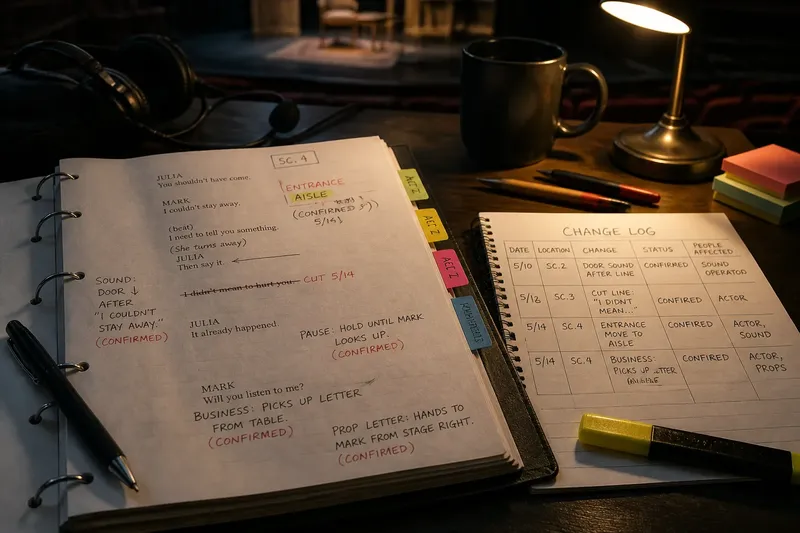
A bound script with clear annotations keeps dialogue, blocking, and cue calls together. The stage manager can see a cue beside the line or action that triggers it, while performers can follow the same page in rehearsal. Tabs, consistent symbols, and a dated revision note make the book easier to scan than a page crowded with unmarked scribbles.
This approach suits a company that rehearses from paper and has a relatively settled script. Its weak point is distribution: a change entered in one person’s book does not automatically reach everyone else. If actors and crew use separate copies, decide which record is authoritative and how revisions will be shared.
A shared digital document suits frequent revisions
A shared document can make updates visible to people who are not holding the prompt book. A table or structured file can separate the location, change, status, and people affected. Version history can help clarify when an instruction changed, while a pinned or clearly dated “current version” reduces the chance that someone opens an outdated file.
This option suits a company already comfortable checking a shared device or folder. It can become hard to use if notes are scattered across chat messages, email, and several documents. Keep the record in one agreed place, and avoid editing the live version during a performance unless the company has a clear process for doing so.
A hybrid record suits productions with different users
A hybrid system pairs a working script with a shared change log. The script holds details needed at the moment of action; the log records revisions and decisions that other departments must see. For instance, a cue may be marked in the stage manager’s script while the log notes that the cue now follows a specific line rather than a movement.
This arrangement helps when performers prefer paper but the director, stage manager, and designers need a common update channel. It also creates a risk of mismatch. Assign one person to reconcile the copies and identify which version is current before rehearsal or performance.
Choose the format your company will actually consult, then make its authority explicit.
Record changes so readers can act on them
A useful entry gives enough context for someone who missed the conversation. “Move table” is vague: which table, from where, to where, and for which scene? Better notes identify the location in the script or production, state the confirmed action, and name the people who need to respond. Add a date or revision marker when the timing matters.
Imagine a company changes a character’s entrance from the doorway to the aisle during rehearsal. The stage manager records the scene and cue, marks the entrance as confirmed, and alerts the actor and the person handling the door sound. At the next rehearsal, both can follow the same version, and the sound operator knows not to fire the old entrance cue. The observable result is a consistent entrance rather than two departments working from different assumptions.
For changes that affect several departments, use a compact entry such as:
- Location: scene, page, cue, or rehearsal section.
- Decision: the exact confirmed change, written in plain language.
- Status: proposed, confirmed, or replaced.
- People affected: the roles or departments that need to know.
- Next action: what must be updated, checked, or communicated.
Keep the wording observable. “Make the pause more tense” describes an intention but may not help an actor repeat it. “Hold until the other actor looks up” gives a playable marker, if that is the agreed choice. A prompt book should record the production’s decision, not invent a new interpretation on the page.
Keep revisions from turning into competing versions
Revisions are easier to follow when the record distinguishes current instructions from superseded ones. Cross out or archive obsolete directions rather than leaving them beside the new note without explanation. If a cut line returns, or a cue moves back, write that as a fresh decision. A reader should not have to infer which annotation wins.
Use a short change log when the update affects more than one person or alters an established sequence. It can say what changed and point to the place where the full instruction lives. Avoid copying the entire note into multiple channels; duplicated records drift when one gets updated and another does not.
There is also a useful boundary: the prompt book is not a transcript of rehearsal. Record settled choices, unresolved items that need follow-up, and information necessary for someone to do their job. Leave out commentary about why a person made a choice unless that reason affects how the choice should be repeated.
Who should maintain the prompt book?
The stage manager commonly maintains the prompt book because the role tracks the production’s sequence and communicates changes across the company. In a small group, the director or another designated person may do it instead. What matters is a named owner, not a particular job title.
People can propose or report changes, but one person should confirm that the record reflects the agreed version. This avoids treating a casual rehearsal note, an actor’s personal reminder, and a production decision as interchangeable. The owner can also flag entries that need clarification before they become hard to reconstruct.
For an amateur company with rotating attendance, make the record easy to consult before each rehearsal. A short review of changed pages, outstanding decisions, and current cue notes can catch gaps while the relevant people are together. Keep the review focused; the book supports rehearsal rather than replacing conversation.
How should a prompt book handle changes?
Should every rehearsal note go into the prompt book?
No. Capture decisions that affect repeatability, cues, movement, design, or another person’s task. Keep unconfirmed ideas clearly marked as pending, or leave them in the director’s working notes until the company decides.
What belongs in a prompt book besides cues?
Useful entries can include confirmed blocking, script cuts, entrances and exits, prop handoffs, scene transitions, and notes that explain a cue’s trigger. Include only details that help the company reproduce or coordinate the agreed production.
How can a company keep paper and digital copies aligned?
Name one authoritative record and one person responsible for updating or reconciling other copies. Give changes a clear date or revision marker, and tell users when an old page or file should be replaced.
When should a proposed change become an official entry?
Record it as confirmed once the relevant people have agreed on the choice and know what action follows. If it still needs a trial or approval, label that status so nobody mistakes a possibility for the current plan.
A prompt book does its quietest, most useful work between rehearsals: it carries the company’s decisions forward without asking anyone to rely on memory. For a production choosing a prompt book format, start with the people who must act on changes, then build the record around how they read and share information. The page is not the production; it is the clearest available account of what the production has decided to do.