The Set That Explains Too Much
Learn how selective stage-set details can clarify a play’s world, focus attention, and leave audiences room to imagine what the scenery cannot show.
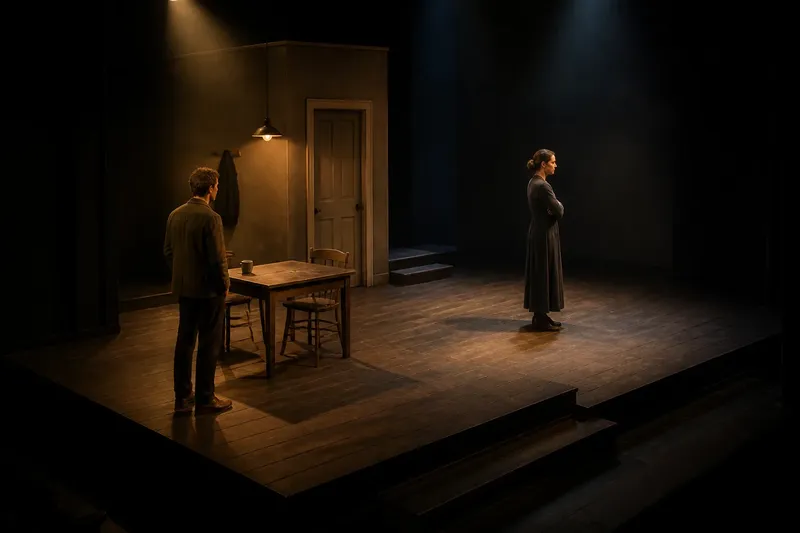
Why can a carefully built set make a play feel smaller? Often, the scenery explains every detail before the actors have a chance to: a painted forest, a fully furnished cottage, and a labeled shop sign leave little for an audience to discover. A selective stage set can establish place and mood with a few vivid cues, then let performance and imagination complete the picture.
1. Choose the detail that tells the audience where they are
A set does not need to reproduce a whole location. It needs to give the audience enough information to read the action. A doorway can suggest a house; a counter and a hanging sign can suggest a shop. The question is not, “What belongs in this room?” but, “Which detail makes the scene legible?”
Start by identifying what characters use or react to. If an actor enters through a door, the door matters. If nobody sits at the ornate desk, and no line refers to it, the desk may be visual noise. This is not an argument for bare stages. It is a way to make each chosen object earn its place.
For a small amateur-theatre stage, one clear doorway and a practical table may tell more than a wall covered in painted windows, framed pictures, and decorative trim. The audience can supply the unseen parts of the room.
Keep the detail that helps the action read at a glance.
2. Let objects carry more than one job
A single object can locate a scene, shape movement, and create atmosphere. A wooden bench might serve as a station platform seat, a park bench, or a courtroom waiting place, depending on the play’s context and how actors use it. Multipurpose scenery is especially useful when the script moves between locations, but it also gives the audience a reason to look at what performers do with an object rather than inspect a literal backdrop.
Choose objects for their stage behavior as well as their appearance. Can an actor sit, lean, place a letter, or move around it without awkwardness? Does its silhouette remain clear from the back row? A realistic object that blocks a face or creates a traffic jam may be less useful than a simpler substitute.
Imagine a group staging a story that moves from a kitchen to a bus stop. They use one sturdy bench and a small table, then shift the actors’ arrangement and a coat on the bench to suggest each place. The expected result is a readable change of location without constructing two complete rooms.
Before adding a second object, ask whether the first can do its work.
3. Use empty space as part of the design
Unfilled space is not automatically unfinished. It can make an entrance feel exposed, turn a gap between actors into a boundary, or keep a tense scene from feeling cozy. When every wall and corner carries a prop, color, or pattern, the eye has no place to rest. A clear area can make a single gesture or object more noticeable.
Think about where the audience should look during a scene. A crowded stage may divide attention between a conversation and background decoration. A quieter arrangement can make a pause feel charged. The actors’ positions, the lighting, and the distance between objects all help shape that visual focus.
Try describing the scene without naming its furniture: “two people avoiding each other in a public place” may point toward a different arrangement than “a fully furnished café.” Leave enough open floor for the relationship to show.
4. Suggest the world instead of illustrating each line
A script may mention rain, a locked room, a family photograph, and a storm outside. That does not mean the set needs a rain effect, a detailed lock, a framed portrait, and a painted lightning-filled sky. Some information belongs in dialogue, sound, lighting, or the actors’ behavior. Scenery can support those elements without duplicating them.
Look for the dominant image of a scene, then select one cue that strengthens it. A narrow shaft of cool light may suggest a bleak morning more effectively than a window covered with imitation frost. A battered suitcase can hint at an unsettled life without dressing the whole stage as a railway platform.
This division of labor keeps the design from competing with the script. It also allows a suggestive cue to change meaning as the scene develops. A chair may first read as a place to sit, then feel like a barrier when a character refuses to move it.
5. Check what the audience can actually read
A detail that looks expressive from the wings may disappear from the auditorium. Fine lettering, small painted objects, and subtle surface textures can lose definition at a distance. Stage design needs a clear visual hierarchy: large shapes first, useful objects next, and small decoration only when it remains meaningful from the seats.
Walk to the back of the performance space and look at the set in ordinary work light. Ask someone who was not involved in making it what location they perceive and where their eye goes first. Their response is not a verdict on the design; it is a clue about what the audience may read quickly.
If a detail matters to the plot, it must be visible or made clear through another theatrical choice. If it does not matter, its absence may make the important object easier to notice.
6. Does a selective stage set need realistic furniture?
What makes a set feel like a real place?
Specific, consistent cues make a place believable, even when the scenery is not realistic. A door used as an entrance, an object handled naturally, and a clear pattern of movement can establish a convincing world.
How many props should a scene have?
Keep the props the actors use and the audience needs to understand the action. Add more only when each item has a distinct purpose, rather than filling empty space by habit.
Can an abstract set still show where a scene happens?
Yes. A change in light, a movable platform, or one recognizable object can suggest a location without depicting it in full. The actors’ behavior and the script’s language can supply the rest.
What should a small theatre build first?
Prioritize elements that affect entrances, exits, safety, and the actors’ movement. Then add the visual cue that most clearly helps the audience understand the scene.
7. Make each addition answer a question
Before building or borrowing another scenic element, ask what new information it gives the audience. Does it clarify the location, support an action, focus attention, or create a useful change in the stage picture? If the honest answer is only “it makes the room look more complete,” pause before adding it.
That question also helps a group make decisions without treating minimal scenery as a rule. Some plays need a dense, detailed environment; others gain power from a bare platform and one suggestive object. The useful choice depends on the script, the performance space, and what the audience must follow. A selective stage set is not a shortage of ideas. It is a way to choose which ideas deserve to be seen.
For the next design discussion, point to the one cue that tells the audience how to read the scene. If that cue is clear, the imagination can take it from there.